

Times: Coach, I saw in your bio that you’re coming to Dover from Scranton. That’s an understandable move. We’ve had teachers before come from Scranton. But I also see that you were born and raised in San Diego, California. How do you get from San Diego to Scranton?
Roby: Well, I got to Arkansas because my parents moved back here when they retired.
Times: Oh, so they were originally from Arkansas.
Roby: My family’s originally, way back originally, from Arkansas. My dad raised us out there, and when they retired and I graduated from college–I only had a history degree and I didn’t know what to do, so I came out here and ended up getting a teaching license.
Times: Where did you . . .
Roby: I started coaching at Cutter Morning Star.
Times: No, I mean, where did you get your classes for the teaching certificate?
Roby: Henderson State.
Times: I saw you got your bachelor’s degree in Arizona.
Roby: Yeah, Northern Arizona State, next to the Grand Canyon, Flagstaff.
Times: Was that a basketball thing, or . . .
Roby: No, Baseball. I played baseball my first two years of college. That was in Colorado. Yeah, I moved around a little bit. I never really wanted to move around, but being a single parent, sometimes, it causes you to have to take off in their best interest, sometimes.
Times: I want to talk with you a little about your son before we’re done. I’ve heard interesting things about him.
Roby: Well, I hope so.
Times: Has he been with you at Scranton?
Roby: Yeah, he’s been with me since he was three. It’s just been him and I for a long time.
Times: But he played at Scranton last year.
Roby: He played at Scranton for the last four. Eighth through 11 was at Scranton.
Times: Let’s get back on track about your coaching history. You started at Cutter, which is near Hot Springs. . .
Roby: Cutter is in Hot Springs, yeah. I was five years at Cutter, I believe, and then I did a year at Pulaski Academy. I just felt I needed a change of environment. That’s why I took the job at Pulaski Academy, and I actually loved it. It’s a great school.
I don’t know if you’re familiar with how Little Rock Christian and Pulaski Academy are tied really closely together. So during that year, I ended up getting to know everyone at Little Rock Christian and kind of got invited to come over to Little Rock Christian by the people I got to know. Their administration wanted me to help build their program, so I moved over to Little Rock Christian and I coached there for three years.
That’s when I made a decision to go back to my family out in California, because I really didn’t have much family here, except for my mom and dad, and I got talked into taking my son out there.
And I didn’t like it. I coached two years in California, but I like the South. I don’t like where I grew up. It’s not the same as it was in the seventies and eighties. So I quickly came back.
And I actually couldn’t find a job in Arkansas immediately when I was trying to get back into Arkansas. There were some jobs in the southern part of the state, but nothing I was familiar with.
So we landed just outside of Dallas for three years. Those were good years. We built up the program in Palmer, Texas, and it was successful.
My son was really starting to develop and really starting to love basketball.
Things were going well, and that’s when I got a call from a friend who told me about Scranton,
He said, “If you ever want to coach at a place without a football team . . .” that was his comment to me. He said there’s a place here in the middle of nowhere with a great tradition and no football, and you may want to look into it if your son doesn’t play football.
I said, “He did. He has, but it might be worth looking into.” So I visited Scranton, and I thought it had a great feel to it, and I still do. Scranton’s a great place. I didn’t run away from it for any reason. I loved it there. That’s a good community of good people who just love basketball, and I’ll miss it, but I just wanted to move up to a higher level.
Times: So you’ve coached in various places for 20 years?
Roby: Yes, this will be 20.
Times: And how many of those were as head coach?
Roby: This will be my tenth year as a head coach.
Times: And your son’s name is Conor?
Roby: With one “n” and an “or.”
Times: And he’s been playing for you at Scranton. Coming here, are you fairly certain he’ll make the team?
Roby: I’m pretty sure. He’s got a pretty good record. He’s got a couple of All-State awards already and a couple of All-State Tournament awards. He’s never lost a district championship–he’s three for three, which makes me a little nervous going up against Arkansas Baptist and some of the other teams you’ve got in this conference, but that really doesn’t matter. It’s not a priority.
He’s made me look good. He’s a good one. He’s got a kind of winning spirit, to find a way to win. I love that. It’s not me; it’s entirely him. He developed it on his own.
Times: Sounds great. I understand you have a practice at noon today. Have you met with the team yet?
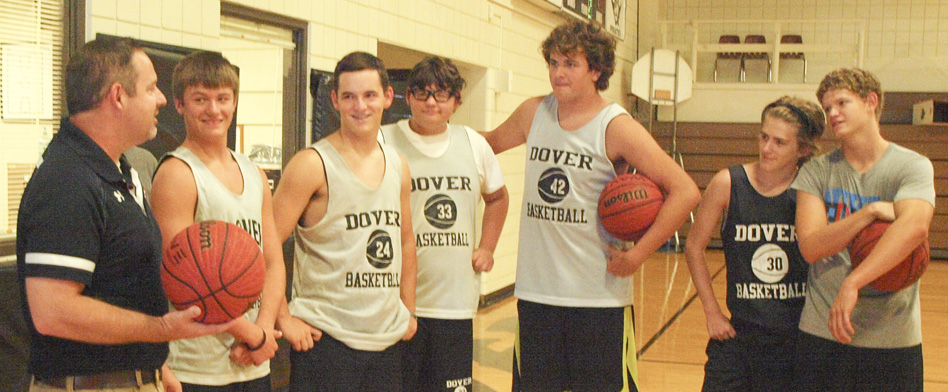
Roby: I’ve met most of them, and we’ve practiced a little bit, nothing I’d really call a practice, where I break it down and we really start going–just some drills where I get to see them shoot.
I let them play a little bit just to see what they can do. We’re very heavily in the evaluation phase. There are a couple of players I haven’t met. There’s one–supposedly a key player–I’m hoping to meet today.
There’s no doubt about it, there are athletes here. In the senior class for sure, there are athletes here. And I think there’s a lot that can be done, if the kids will accept a little bit of change and will buy into a new process. We can win quite a few games.
Times: They ought to be used to change. You’re the third head coach in three years.
Roby: Yeah, that’s bad. And you can see it. Really, I don’t have any negative feelings at all, coming in and seeing the players, but you can see the effect of all that change.
I can see it because they’re . . . to use the analogy of the iceberg, where everything’s beneath the surface,
You watch them and you see their athleticism, but what you don’t see is the smart decisions that basketball players learn over time. I’m going to have to take control and put them in a situation . . .
Times: Where they can have consistency in development.
Roby: Yeah. This will be one of those teams that I hopes peaks in February. I don’t know, we may win games early, too. I don’t know what the schedule exactly looks like.
But my plan will be to peak in February. That’s when we’ll be playing our best, and that when the football players who come in will have had time to learn the system.
Times: I want to talk about that a little bit. You said one of the draws of Scranton was that they didn’t play football. How much of your roster here are you going to be sharing with the football program?
Robey: Post player. Key post players. Seth Cheak, Luke Price, Dalton Hastings. Pretty darn good players.
One of the things is, it’s funny you should say that: Yes, I was drawn to Scranton for the lack of football.
But by the time I left Scranton, I had commented multiple times to multiple people that I missed football. There’s a reason: The one gripe I had in the four years I was at Scranton was we lacked toughness. We really did. We lacked toughness.
We didn’t like to take charges and go down, we didn’t like contact with other players. We were skilled and could shoot, but we lacked just physical toughness.
And I missed that, because when I’d had teams before, I might have only two or three weeks to prepare, but we sure didn’t [lack toughness]. I didn’t ever have to tell anyone to go get on somebody, to go work, they’d just have that about them. And I missed that.
And so I’m excited about it.
Times: And their conditioning . . .
Roby: Yeah! Physically strong, kids who are six two, six three, two hundred and something pounds–I just love that. And they’ll still have plenty of time to prepare between November and February. We’ll get there.
I don’t have that mentality I had early on where I’d think, “I’ve got to have my kids 365 days a year.” I would like to have them in blocks throughout the year, but I’ll encourage them: You want to play football? Go play. You want to play baseball? Go play. Be well-rounded. Just make sure, when I have a few practices here and there, that you get better. That’s what I need.
Times: Let’s talk a little about moving into a new conference here and what you see. I think you mentioned a couple of teams earlier that you thought were going to be challenging. What’s your outlook on the conference?
Roby: From what I can see, it the toughest conference in Arkansas for 4-A. I know Arkansas Baptist has a seven four and a seven one player.
Times: I remember them from last year.
Roby: Yeah, they’re young, and they’re moving up a guard, who’s, I’m told,I haven’t seen him play, but I’m told is one of the best guards in Arkansas as a freshman for them and they’ll move him up. They say he’s unbelievable.
And, you know, there’s Dardanelle. They’re well-coached; they play hard; Dardanelle’s got athletes.
Everybody’s good. Pottsville’s got players. Subie always manages to reload, plus being well-coached.
I’m used to the situation at Scranton, where you’ve got Scranton and County Line at the top. Then you’ve got Kingston who was well-coached and scrappy, always fighting and could always knock you off at any moment.
Mulberry was kind of similar. With Mulberry, you had to be careful, but in the bottom half of the conference was always a walk.
You really only had to play two or three night a year to get where you wanted to be in the region. And in the region, so long as you get that first-round win, you’re in state.
It going to be a different mentality here. Here, we’re going to play every night. It’s just going to be a battle every night.
I like the kids I’m going to go in with, though. I like the looks of them physically. I like the aggressiveness. I’ll just have to install the when-to-be where-to-be and the decisions to make because I’ve noticed the shots we take are not always the shots I want them to take.
I don’t mind all the kids shooting, as long as they’re shooting from where they shoot best.
There are some kids who are not three-point shooters. Get your feet in the lane and then jump up and shoot. That’s their strength.
I’ve got two kids I consider three-point shooters, but when they put it on the floor and try to get into the lane, things tend to snowball out of control for them and they turn the ball over.
It’s just getting kids to understand roles. That’s what I think my job’s going to be here, getting kids to play roles based on what they do best.
And just getting them to be excited about it.
You’ve got to love basketball. It’s hard work. You’re performing in front of the crowd and they can see you real well, as opposed to some sports where you get to kind of hide.
You don’t get to hide out here. You’re right there with the crowd looking at you and when you make a mistake, it’s on display for everybody in the world to see, so it’s a tough sport for kids.
They have to love it.
Times: Okay. Anything else to add that you want on the record?
Roby: Well, if I said anything ridiculous, will you edit it out?
Times: No.
Roby: Well, if the Dover community’s going to read it, I would like everybody to know that I’m really, really excited. I mean, honestly, I haven’t been this excited about going somewhere in a long time. I feel like I’m where I’m supposed to be. It just feels that way.
And because there’s been so much turnover over the years, I really sense a lot of concern that we’re going to come in, Conor’s going to graduate, and we’re going to look to go.
That’s really not my plan. I have a great relationship with Coach Melton. I look forward to be working with him and Coach Stiles and Coach Heath. I just think this is going to be a lot of fun and a good place to work. And we’ll build.
At the end of this year, we’ll graduate 11 guys and we’ll have to rebuild, but I think it can be done. I like some of the young kids. Seth Cheak’s only a junior. When you see Seth, you think how in the world can that kid just be a junior?
But I’m excited. One of the things people said when they’d try to talk me out of applying was, “Oh, you’ll only have one year, then it’ll all fall apart.”
And I’m not going to take people’s word for that. Let me see. And we’ve got a few bodies that, give them the right environment, they can thrive. I do not think we’ll fall to the cellar after graduation. That does not have to happen.
It’ll take work, and everyone staying healthy, but I’d like the chance to build something and give these kids some stability, which is clearly what they need.
OLYMPUS DIGITAL CAMERA
Roby marks 20 years in coaching with first year as a Pirate
0
Share.


